
Endoscopic facelift is a cutting-edge way to make the face look younger by restoring its natural contours with as little damage and as much accuracy as possible. With small cuts and an endoscopic camera, surgeons can lift and move the tissues under the skin without leaving big scars or taking a long time off work.
Endoscopic facelift is a new way of treating early to moderate signs of ageing, such as sagging brows, loss of volume in the midface, and deep facial lines, and still lets you make natural facial expressions. Because of this, people who want subtle, long-lasting, and scientifically proven anti-ageing results now prefer the endoscopic facelift.
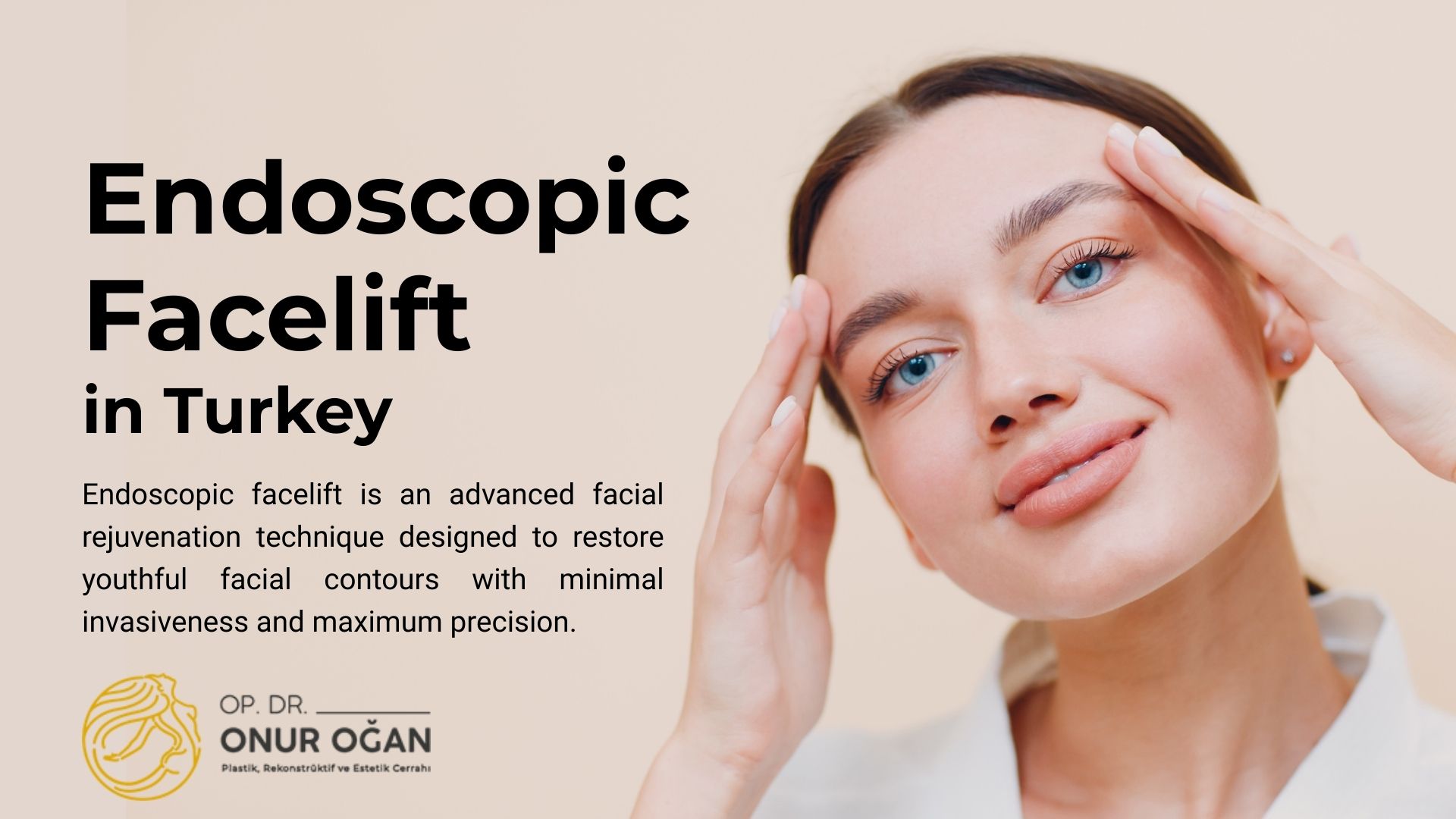
In facial aesthetics, erasing the signs of time is not just about tightening the skin but about preserving the natural architecture of the face and returning the tissues to their original positions. Endoscopic facelift operations are performed under the leadership of Op. Dr. Onur Oğan provides permanent and natural rejuvenation with the help of modern technology, without making large incisions, unlike traditional methods. This method, which targets sagging in the upper and middle sections of the face, allows patients to achieve a rested and refreshed look rather than a ‘pulled’ appearance.
The gold standard of modern surgery, the endoscopic facelift promises natural rejuvenation by returning tissues to their original positions before ageing.
Ageing is not just the sagging of the skin, but the downward displacement of deep tissues, fat pads and muscle structures due to gravity. This can create a tired, sad and low-energy expression in patients, leading to a loss of self-confidence. Endoscopic techniques offer a technological art form that treats the face holistically, like a ‘mask,’ lifting these structures vertically to preserve the face's three-dimensional architecture.
The clearest answer to the question ‘What is endoscopic facelift?’ is that it is a minimally invasive surgical method performed using high-resolution camera systems. Whereas traditional facelift operations require large incisions that start in front of the ear and extend to the hairline, sometimes leaving visible scars, the endoscopic method requires only a few small entry points of 1-2 centimetres, hidden within the scalp.
The greatest advantage this technology offers the surgeon is the ability to magnify and view the underlying structures—nerves, blood vessels, muscles, and connective tissue (SMAS)—on large screens using an endoscope (a thin, lighted camera tube). This allows the operation to be performed with millimetre precision while minimising tissue trauma. The primary reason for less bruising and swelling compared to traditional methods is the meticulous work performed under this high-resolution imaging. For patients, this means not only a safer surgery but also a much faster recovery process.
The midface, which encompasses the cheeks and under-eye area, is the region where the signs of ageing are most pronounced and which drives patients to seek surgical intervention. Over the years, the effects of gravity cause the fat pads on the cheekbones to sag downward. This leads to a loss of fullness in the cheeks and deepening of the lines running from the sides of the nose to the corners of the mouth (nasolabial folds). Endoscopic mid-face lift aims to correct volume loss and sagging in this area.
With Endoscopic Midface Procedure:
A midface lift restructures the centre of the face, giving it a more energetic and healthy appearance. It is often preferred by patients experiencing ‘filler fatigue’, i.e. those who are tired of temporary solutions and want a more permanent and structural result.
The operation is performed under general anaesthesia in a fully equipped hospital environment. The process can be summarised in the following technical steps:
The duration of the surgery can vary between 2 and 4 hours, depending on the scope. This vertical lift from the temple area gives your face a fresh look, as if you had pulled your hair back tightly.
|
Feature |
Endoscopic Facelift |
Traditional Facelift |
|
Incision size |
1-2 cm (small) |
Wide (Front/back of ear) |
|
Risk of scarring |
Minimal, hidden within the hair |
More noticeable scars may occur |
|
Target area |
Upper and midface |
Lower face, chin and neck |
|
Recovery process |
1-2 Weeks |
3-4 Weeks |
|
Surgery time |
1.5 - 3 hours |
3 - 5 hours |
The answer to the question of how long endoscopic midface lift lasts depends on individual factors, but the results generally last between 7 and 10 years. In some cases, this period may be extended depending on lifestyle and skin quality. Although ageing is a natural process, people who have had this surgery always continue to look younger and more dynamic than their peers.
Factors affecting the longevity of results include:
It should be remembered that ageing does not stop biologically, but you will continue to look much younger than you would have without surgery even 10 years later.
Endoscopic facelift recovery time is much faster than traditional facelifts. Patients are usually discharged after spending one night in hospital under observation.
Although tissue damage is minimal thanks to the use of a camera, neurological weakness in the forehead area and sensitivity in the nerves around the cheeks and mouth usually fully resolve within 1-3 months.
Endoscopic facelift patients often state that when they look in the mirror after the operation, they feel like they did ‘10-15 years ago’. The patients' greatest source of satisfaction is that their facial expressions are not lost and their face does not look ‘operated on’. Many patients report that just a few weeks after the procedure, no one can tell they have had cosmetic surgery; they simply look more rested.
The ‘best’ candidates for this operation are generally individuals in their late 30s to early 50s who experience mild to moderate sagging. Candidates for endoscopic facelift typically have the following requests:
If there is significant excess skin in the neck area, endoscopic lift alone may not be sufficient. In this case, Deep Plane Facelift would be a more rational option. Endoscopic facelift is fascinating because it is ‘scarless’, but it works wonders when performed on the right patient with the right indication.
Patient compliance is critical for a successful endoscopic facelift pre- and post-operative process. Three-dimensional analysis systems using 3D imaging are employed to evaluate the facial skeletal support and soft tissue volume prior to surgery. This enhances the predictability of the outcome. Prior to the operation, blood-thinning medications (such as aspirin) should be discontinued at least 10 days beforehand, and smoking should be stopped as it slows down recovery.
Endoscopic midface lift prices and endoscopic facelift surgery prices vary depending on the scope of the procedure, other aesthetic procedures added to the operation (eyelid aesthetics, fat injection, etc.), and the surgeon's experience. As individual planning is required, the exact price can only be determined after a detailed physical examination.
When evaluating the cost, considering the long-term permanence of the endoscopic method, it can be said that it is a more economical option compared to non-surgical methods such as fillers or thread lifts, which need to be repeated.
Endoscopic facelift prices in Antalya can be obtained after a preliminary assessment by Op. Dr Onur Oğan. Contact us for more detailed information and to make an appointment.
Aesthetic surgery is not merely an anatomical change but a rejuvenation of the connection a person has with their true self. Dr Onur Oğan prepares a personalised treatment plan for ‘naturalness based on science, without exaggeration’. In procedures such as endoscopic facelift, which require high technical skill and technological infrastructure, the primary goal is to preserve the individual facial characteristics of my patients and transport them to a timeless freshness.
If you look in the mirror and cannot see that old dynamic energy, call us for a personal analysis and a treatment plan tailored to your needs.
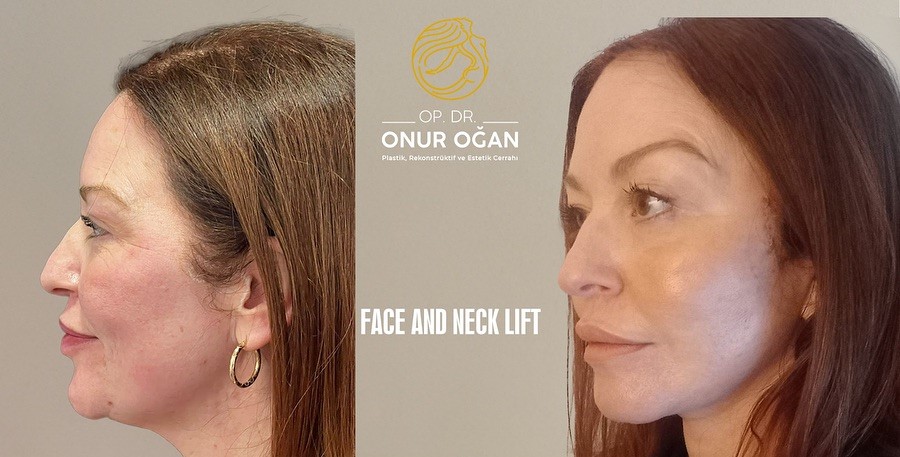
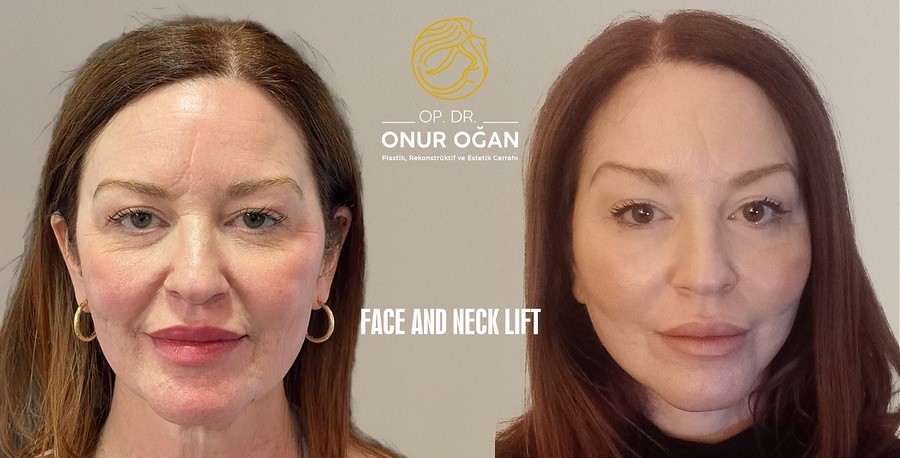
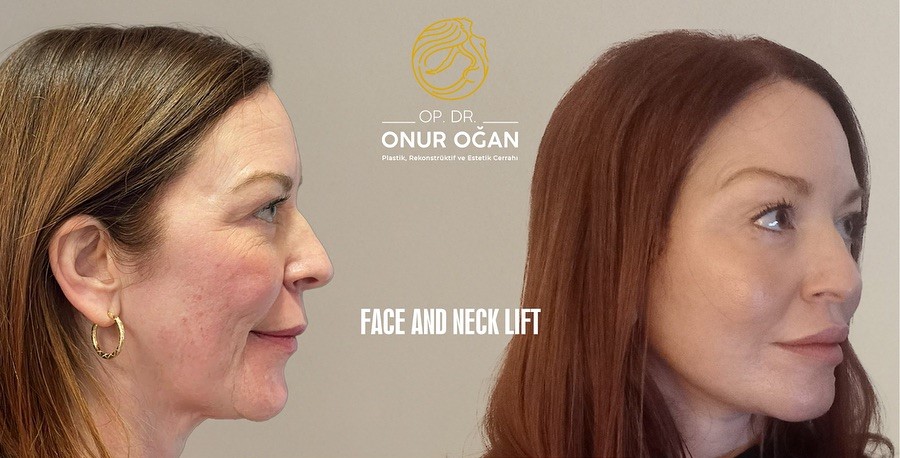
As the operation is performed under general anaesthesia, no pain is felt. Afterwards, there may be a slight soreness or tightness, which can be controlled with simple painkillers. It should be remembered that the sensation of pain after a facelift varies from person to person.
No, as the incisions are made in the scalp and temple area in the form of small 1-2 cm holes, there is no visible scarring.
The main difference is the size of the incision and the depth of the procedure. The endoscopic method is performed with 1-2 cm incisions within the hairline, targeting the deeper layers beneath the ‘mask’, while the classic method involves wider incisions around the ear, focusing more on the skin and subcutaneous tissue.
The incisions are hidden within the scalp. Once healing is complete, even your hairdresser will struggle to spot these millimetre-long scars.
Generally, the ideal age range is between 35 and 50. During this period, when skin elasticity is preserved but deep tissue sagging begins, 80% of patients report ‘excellent’ satisfaction.
No. On the contrary, because we remove unnecessary tension from the muscles and return them to their natural positions, facial expressions become more dynamic and lively.
Endoscopic techniques primarily focus on the upper and middle face; they may need to be combined with traditional facelift methods for sagging in the neck and prominent jawline.
Patients recover quickly and can usually return to work and social life within 7-10 days.
Yes, endoscopic facelift preserves facial expressions and achieves a natural appearance because it lifts not only the skin but also the deep tissues.
To get more and detailed information, it's best to consult a board-certified Op. Dr. Onur Oğan experienced in performing facelift procedures.