
“Will it leave a scar?” If you have been researching a facelift, you have almost certainly asked yourself this question. After all, your face is the one part of you that is on show all day long: in the mirror, on camera and in front of everyone you meet. The honest answer is that it would not be true to say a facelift leaves no scars at all. Surgical incisions usually leave a scar once they heal, but how noticeable that scar becomes varies from person to person. In facelift surgery the real question is not “will there be a scar?” but “where will the scar sit, and how visible will it be?” The good news is that a surgeon has quite a few options here.
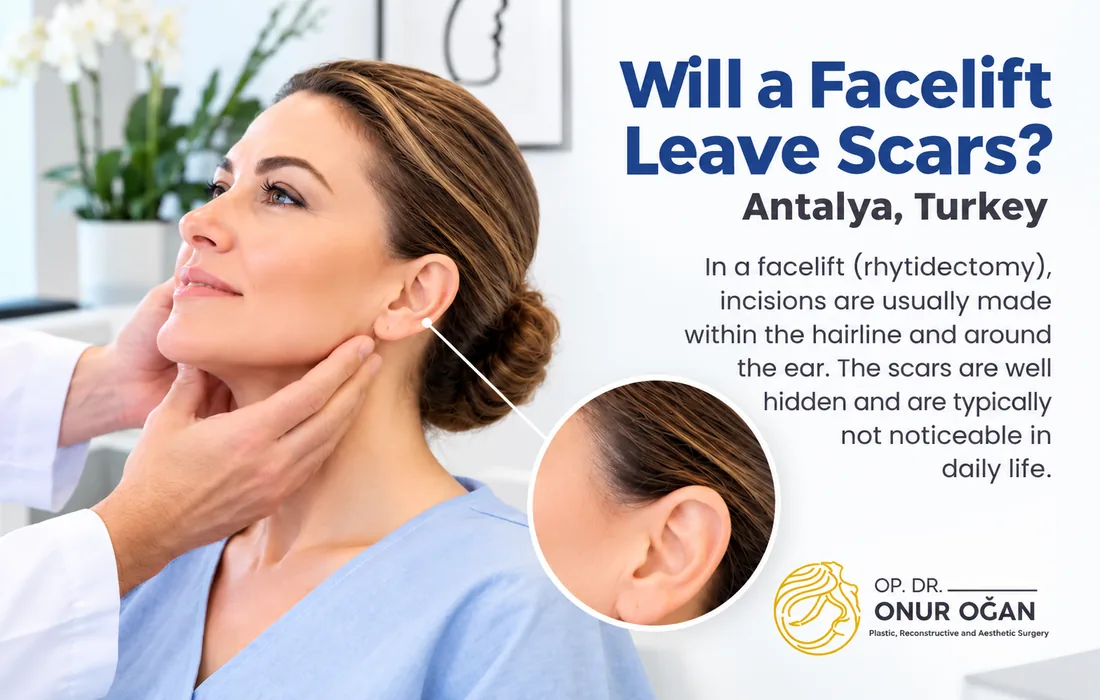
In this article we explain everything you may be wondering about facelift scars: where the incisions are made, how scars change over time, what makes them more or less visible, and when you should speak to your surgeon.
The secret is not so much the incision itself as where it is placed. A surgeon does not position facelift incisions at random. They are planned to run within the hairline, in front of and behind the ear and, when needed, into the scalp. Why? Because these areas are not very noticeable in everyday life: your hair and the natural folds of your ear hide the line.
The larger the procedure, the longer the incision may need to be. In a more limited procedure such as a mini facelift the incision can be kept short, whereas in a face and neck lift the incision line may extend a little further. With the endoscopic facelift technique the incisions are small and few in number. It is important to be clear, though: this does not mean “no scars at all”, only that the incisions are confined to a much smaller area.
If you look in the mirror shortly after surgery and see a red, sometimes slightly raised incision line, there is no need to panic: this is a perfectly normal stage of healing. In the first weeks the redness is at its most visible because blood flow to the area increases and the new collagen has not yet “matured”.
As time passes, the appearance softens. The red tone first turns pink and then gradually moves closer to the colour of the surrounding skin. This fading usually takes a few months, while it can take anywhere from six months to a year for the scar to fully mature. In other words, the scar you see two weeks after surgery is not the scar you will see a year later; the healing process is still going on.
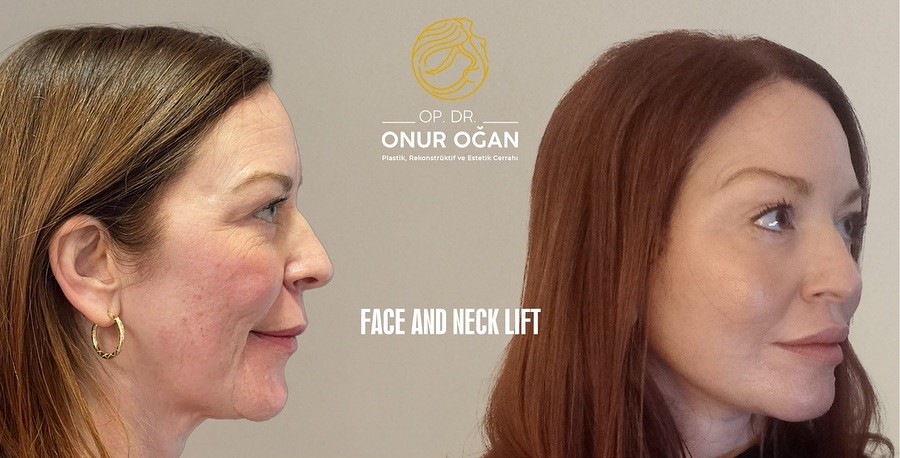
One of the most common questions we receive is about scarring after surgery.
“Will I have visible scars after a face and neck lift?”
The aim is to keep scars as discreet as possible; their final appearance varies from person to person.
Incisions are planned around the ears and hairline to help conceal scars. Scars may become less noticeable as they heal, but their visibility depends on individual healing and cannot be guaranteed.
Remember, each patient heals differently, but we always aim for natural, seamless results.
Two people who have the same operation can end up with scars that look quite different. This is actually very common, and there is no single reason for it.
Your skin type and genetic tendency play an important role. Some skin heals quickly and smoothly, while in other skin the scar tissue may stay thicker or the redness may last longer. In people prone to keloid or hypertrophic scarring, healing follows a different course altogether. How evenly the surgeon distributes tension on the skin when closing the incision also influences whether the scar stays fine or becomes wider.
Smoking and nicotine really deserve a section of their own: they reduce blood flow to the skin, slow healing and increase the chance of the scar staying noticeable in the long term. Early sun exposure carries a similar risk, because immature scar tissue can darken permanently if it is exposed to the sun. On top of this, how closely you follow your doctor’s dressing and follow-up schedule has a direct effect on the result.
We would also like to add that nothing you read online is a guarantee of how your own healing will go. Your personal risk and healing profile can only be assessed together with your surgeon after an examination. If you would like to read more on this subject, see our article on facelift risks and complications.
Making a scar disappear completely is not in our hands, but making it less noticeable is genuinely possible. The first step is to stick to the dressing and cleaning instructions your doctor gives you. Protecting the area from direct sunlight until the incision line has fully healed, and using a suitable sunscreen when needed, is just as important. Other steps include staying away from cigarettes and all tobacco products as much as possible, regularly using scar care products approved by your doctor (such as silicone gel or silicone tape), and cleaning the area gently without rubbing or pulling. Attending all your follow-up appointments also lets you and your doctor monitor the healing together.
None of these promises that the scar will be “erased”, but they reduce the factors that make healing harder as much as you can. For more aftercare advice, you can also read what to do after a facelift.
Redness that gradually fades, or slight firmness along the incision line, is expected and is nothing to worry about. However, if you notice increasing redness, warmth or discharge, a scar that becomes thicker and more raised instead of flattening over time, a new opening along the incision line, or severe itching and pain around the scar, do not ignore it. Each of these signs does not necessarily mean a serious problem, but they all deserve to be checked.
Yes, they do; but the incisions are usually planned in areas that are not very noticeable, such as the hairline and around the ears. The final appearance of the scar varies from person to person.
Scar tissue gradually changes from red to a tone close to your skin colour. This usually takes a few months, while full maturation of the scar can take between six months and a year.
Smoking and other tobacco use, exposing the incision line to the sun in the early period and not following aftercare instructions can increase the risk of the scar staying more noticeable.
In endoscopic techniques the incisions are usually smaller and fewer, but this does not mean there will be no scars at all. How visible the scars are still depends on your skin type and how you heal.
You should share this with the surgeon who performed your operation. After an examination, additional scar care recommendations or an assessment can be offered depending on how the scar looks.
To learn more about facelift scars and to get a personal assessment for a facelift in Antalya, Turkey, please contact Op. Dr. Onur Oğan.
Medically reviewed by Op. Dr. Onur Oğan, Plastic, Reconstructive and Aesthetic Surgeon ·
“This page is for informational purposes only. For diagnosis and treatment, please consult your doctor.”
Plastic, Reconstructive and Aesthetic Surgeon
Graduated from Akdeniz University Faculty of Medicine and completed his specialist training in the Department of Plastic, Reconstructive and Aesthetic Surgery at the same university. In 2020 he passed the European Board of Plastic Reconstructive and Aesthetic Surgery examinations in Brussels and Oxford and was awarded the FEBOPRAS title. He has been seeing patients at his private clinic in Antalya since 2021.